Digitaler Produktpass
Prototyp RKB-REITZ - RKB-BAT-LI10S8P27,2Ah-18650
Batterie für leichte Verkehrsmittel (LMT)
- Status des Passes
- Aktiv
- Letzte Aktualisierung:
- 22.10.2026
- Seriennummer
- 000050
- Herstellungsdatum
- September 2026
- Modellkennung
- RKB-1.004.1689
- Chargennummer
- FF261694
- Masse (gesamt)
- 6,5 kg
- Batterie-ID
- https://dpp.rkb-reitz.de/p/RKB-1.004.1689/10/FF261694/21/000050-49C1
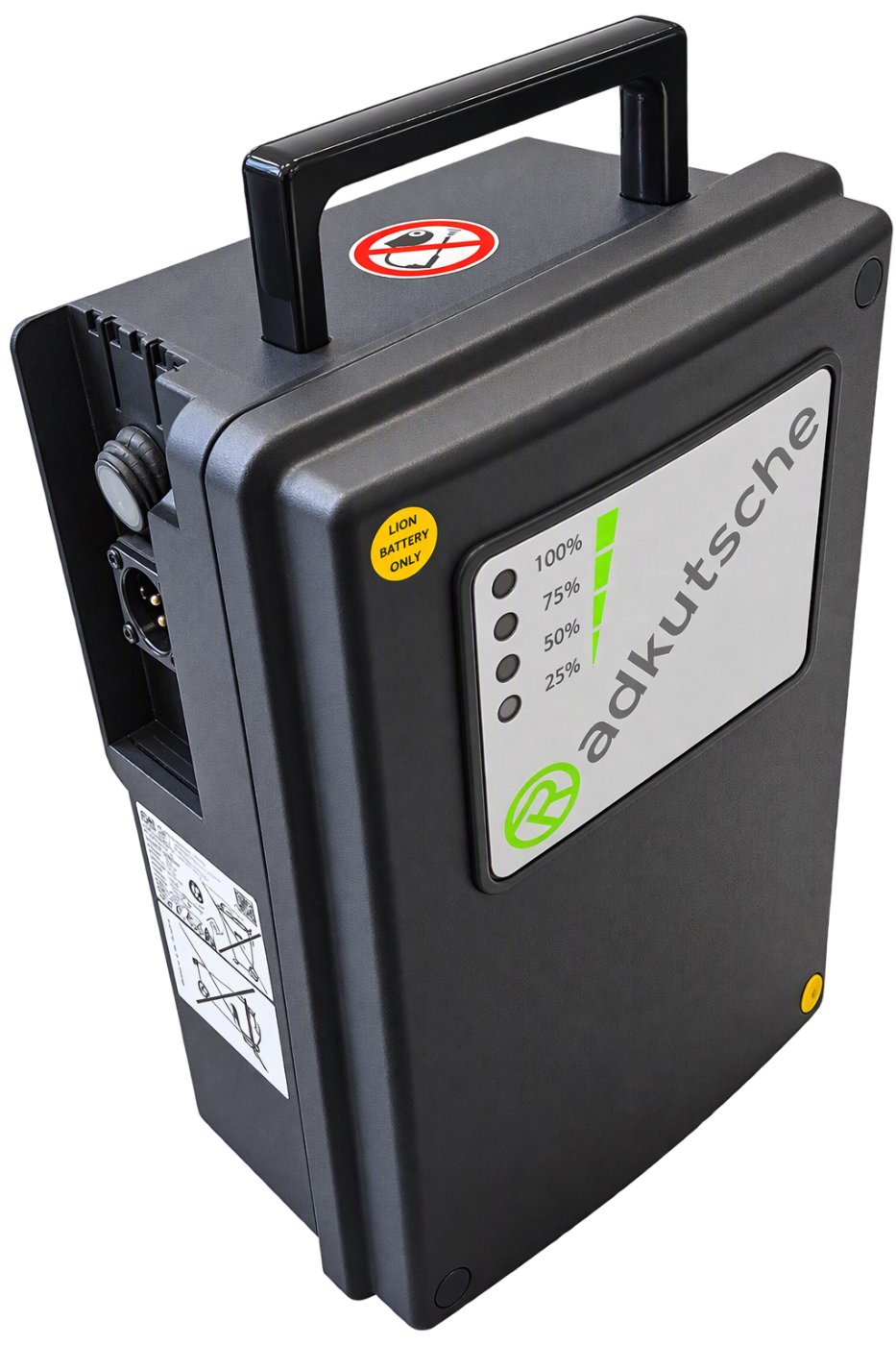
36V Li-Ion Akku für Lastenfahrräder
Der Lithium-Ionen-Akku ist für den Einsatz in elektrischen Lastenrädern ausgelegt. Er versorgt den elektrischen Antrieb zuverlässig mit Energie und unterstützt den emissionsfreien Transport von Waren und Gütern im urbanen und gewerblichen Einsatz.
2Brandschutz, Konformität & Symbole
Brandschutz
- Löschmittel
- Trockener Sand, Vermiculit, Schaum, fully immersed in water.
- Brandklasse nach EN 2
- A: feste StoffeB: flüssige oder flüssig werdende Stoffe
Konformität
- DoC-ID
- KE-AK-1.004.1689-R.001
- EU-Konformitätserklärung (PDF)
- EU-Konformitätserklärung_DE_EN_1.004.1689.pdf
Symbole
Getrennte Sammlung
Nicht über den Hausmüll entsorgen. Altbatterien getrennt sammeln und bei einer Sammel- oder Rücknahmestelle abgeben. So werden wertvolle Rohstoffe zurückgewonnen und Schäden für Umwelt und Gesundheit vermieden.
CE-Kennzeichnung
Der Hersteller erklärt, dass die Batterie die für sie geltenden Anforderungen der EU erfüllt. Die Einzelheiten stehen in der EU-Konformitätserklärung.

Firefighting and Emergency Measures (Fire Class A)
Dry sand may be used to contain small battery fires. Damaged or critically defective batteries should be placed in designated lithium-ion safety bags or approved transport containers. In emergency situations, controlled immersion in water may be used for cooling purposes and to prevent fire propagation, provided this is permitted by the applicable emergency response procedures.

Explosion Hazard
Improper use, mechanical damage, or exposure to extreme heat may create an explosion hazard. Only use approved chargers and accessories specified for the battery system.

Fire Hazard
Lithium-ion batteries may cause fire if handled improperly. Do not open, crush, puncture, short-circuit, incinerate, or expose the battery to temperatures outside the specified operating limits.

Environmentally Hazardous Substances
Lithium-ion batteries must not be disposed of improperly. Damaged or exhaust batteries must be disposed of in accordance with applicable local regulations and through appropriate recycling or disposal channels

Do Not Use a Damaged Battery
Do not use batteries that are deformed, swollen, overheated, leaking, or mechanically damaged. Immediately discontinue use and dispose of the battery in accordance with applicable regulations.

Keep Dry
Protect the battery from moisture, water, and other liquids. Ingress of liquids may cause short circuits or permanent damage to the battery.

Refer to the Instruction Manual
Read and follow all safety, installation, operating, charging, storage, and disposal instructions before using the battery.
3CO₂-Fußabdruck
Noch nicht erforderlich, Angabe folgt.
4Lieferketten-Sorgfaltspflichten
Die Sorgfaltspflichten für die Lieferkette nach Kapitel VII der Batterieverordnung (Art. 48 bis 53) gelten für diesen Wirtschaftsakteur nicht. Grundlage ist die Ausnahme nach Art. 47 der Verordnung (EU) 2023/1542.
5Materialien & Zusammensetzung
- Batteriechemie
- Kurzbezeichnung der Batteriechemie
- Li-ion NMC (Kathode: Lithium-Nickel-Mangan-Kobalt-Oxid)
- Aktivmaterial Kathode
- NMC811 (LiNi0.8Mn0.1Co0.1O2)
- Aktivmaterial Anode
- Graphit (C)
- Elektrolyt
- Lithium-Metall (Li)
- Kritische Rohstoffe (CRM)
Rohstoff CAS-Nummer Nickel 7440-02-0 Cobalt 7440-48-4 Graphite 7782-42-5 - Gefahrstoffe (SVHC)
Stoffname CAS-Nummer EG-Nummer Masse Konzentration Nickel compound 1313-99-1 – 0 kg 0–80 % Manganese compound 1313-13-9 – – 0–15 % Cobalt compound 1307-96-6 231-158-0 – 0–15 % Polyvinylidenfluorid (PVDF) 24937-79-9 – – < 5 % aluminium foil 7429-90-5 – – 2–10 % styrene-butadiene-rubber 9003-55-3 – – < 1 % Copper Foil 7440-50-8 – 0,13 kg 2–10 % carbon 744-44-0 – – 10–30 % electrolyte 96-49-1 – – 10–20 % - Gefahrstoffe gesamt
- 24–186 %
- Auswirkungen der Stoffe
- Lithium-ion batteries contain various materials and chemical substances, including lithium compounds, transition metal oxides, graphite, electrolytes, and other components. Under normal operating conditions, these substances are safely contained within the battery housing and do not pose a risk to users or the environment. Improper handling, mechanical damage, overheating, fire, or misuse may cause the release of hazardous substances. Exposure to electrolyte liquids, gases, vapors, or combustion products may result in irritation of the skin, eyes, and respiratory system and may pose health hazards upon prolonged or significant exposure. Damaged or improperly disposed batteries may contaminate soil, groundwater, and surface water and may adversely affect ecosystems. To minimize environmental impact and prevent potential risks to human health and safety, batteries shall be collected separately, recycled, and disposed of in accordance with applicable regulations. Appropriate precautions shall be taken during storage, transportation, use, and disposal to prevent short circuits, mechanical damage, thermal events, and the release of hazardous substances. In the event of damage, leakage, overheating, or fire, the battery shall be isolated and handled according to the applicable emergency procedures. Residual Risk: Despite compliance with applicable safety requirements, a residual risk of fire, thermal runaway, release of hazardous substances, and environmental contamination remains in the event of severe mechanical, electrical, or thermal abuse. Users shall follow all safety instructions provided by the manufacturer to reduce these risks to an acceptable level.
6Kreislaufwirtschaft & Ressourceneffizienz
- Recyclatanteile
Recyclatanteil davon aus Produktionsabfall davon aus Altbatterien Cobalt 0 % 0 % 0 % Nickel 0 % 0 % 0 % Lithium 0 % 0 % 0 % Blei 0 % 0 % 0 % - Gesamtanteil erneuerbarer Materialien an der Batterie
- 0 %
Sammlung und Abfallvermeidung
- Dokument
- Waste Information.pdfEnthält: Beitrag der Endnutzer zur Abfallvermeidung · Beitrag der Endnutzer zur getrennten Sammlung
- Sammlung, zweites Leben und Behandlung
- Waste Information.pdf
7Leistung & Haltbarkeit
Kapazität, Energie & Spannung
- Nennkapazität
- 27,2 Ah
- Min. Spannung
- 25 V
- Nennspannung
- 36,35 V
- Max. Spannung
- 42 V
Leistung
- Anfangsleistung bei 80 % SoC
- 1.200 W · gilt für 5 °C bis 40 °C
- Anfangsleistung bei 20 % SoC
- 900 W · gilt für 5 °C bis 40 °C
- Max. zulässige Leistung
- 1.260 W
Round-Trip-Effizienz & Selbstentladung
- Anfängliche Round-Trip-Effizienz
- 90 %
- Round-Trip-Effizienz bei 50 % der Zyklenlebensdauer
- 85 %
- Anfängliche Selbstentladerate
- 3 %/Monat
Innenwiderstand
- Anfänglicher Innenwiderstand (Pack)
- ≤ 30 mΩ
- Anfänglicher Innenwiderstand (Zelle)
- ≤ 40 mΩ
Lebensdauer
- Erwartete Ladezyklen
- 700
- Referenztest der Zyklenlebensdauer
- IEC 62620
- C-Rate des Zyklentests
- 0,2 A/Ah
Temperaturbedingungen
- Temperaturbereich außer Betrieb
- 5 bis 40 °C
- Referenztest des Temperaturbereichs
- RKB-_Li-NCM_Summary_26-175-00 (1).pdf
Betreiber, Hersteller und Herstellungsort
Passdaten
- Pass-ID
- https://dpp.rkb-reitz.de/dpp/3a1d00be-f11b-4f25-ad0b-ee7fff3169f4
- Granularität
- Einzelstück
- Schema-Version
- EN 18223:2026
- Inhaltsvorgaben
- Regulation (EU) 2023/1542, Annex XIII; DIN DKE SPEC 99100:2025-02