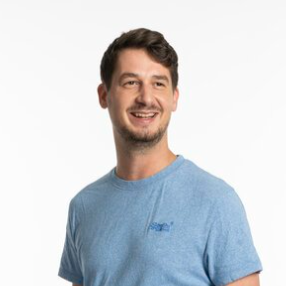
Nico Kimpel, industrial engineer and circular economy consultant
Since my master’s degree I have focused on one question: how can products and materials be kept in the loop while companies benefit from doing so?
I take the perspective of both production and recovery. I think in holistic systems and am genuinely interested in how your operation works and what potential lies within it.
After roles in the automotive industry, in retail and four years at the German Institute for Standardization, I am now starting out as an independent consultant. The reason is simple: I want to bring my experience and know-how into different companies and industries in a focused, project-based way, to keep learning and to drive progress.
Many companies have set out to take all three dimensions of sustainability more seriously. The start is often full of hurdles and the path uncertain. With a structured approach I help close these gaps and make complexity manageable.
I live in Berlin and work throughout Germany.
Why circular economy?
Industrial engineering was the logical choice for me: I always enjoyed mathematical thinking and had a technical bent. At the same time I developed an early eye for economic and social connections.
After my bachelor’s I took time out and travelled for six months. What I saw in Central America, among other places, stayed with me: waste on the roadside, people throwing their packaging out of the bus window. Often there is little awareness of the damage this can cause. But systemic solutions do not work without proper waste infrastructure. Why do we make things in such a way that we frequently can do nothing more with them after a short time, or at the latest after a first phase of use?
The compelling ideas of Prof. Michael Braungart’s cradle-to-cradle concept convinced me. Not a mindset of doing without, but a clear demand: products must be designed from the outset so that their materials can flow fully back into the technical or biological cycle, regardless of function. For me it was clear that, as an industrial engineer, I wanted to work where decisions about design, production and logistics are made.
Background
TU Dortmund
Bachelor’s and master’s in industrial engineering. The programme combined engineering foundations in mechanical engineering, production technology and materials with business subjects such as supply chain management, logistics and controlling. This combination shaped my view of technical systems and my commercial thinking.
ALDI Nord, reverse logistics
Master’s thesis on keeping plastic packaging in the loop in food retail: “Developing a process model for integrating plastic packaging into a closed material cycle.” This is where I got to know metric-based assessment of waste-management activities and circular economy as a measurable operational topic.
BMW AG, New Technologies
Assessing plastics in the vehicle interior for circularity. Initiating experiments with novel materials. Circular economy in product development at one of Germany’s most demanding industrial companies. At the same time it became clear to me: optimising individual components is not a systemic lever. At the end of a long vehicle lifecycle, cars rarely end up where plastic parts can still be recycled by type. Industry-wide solutions and common standards were needed.
DIN e.V., Berlin
Only when different manufacturers agree on similar materials and common standards does circular economy become economically viable at scale. That is exactly what standardization is for, which is why I wanted to understand the system behind it in detail. For four years, as a project manager, I supported research projects on plastics cycles, the digital battery passport and many other topics. Proximity to standardization helps to see where companies should position themselves strategically at an early stage.
Standardization work
In the BMWK research project ELSTA I initiated the creation of DIN DKE SPEC 99100. It is the first German standardization document in the DPP field and defines data attributes for the battery passport. This SPEC forms the basis for further Digital Product Passports under the ESPR. Combining hands-on consulting experience with standardization work at European level is a central part of my approach.